
01 · Indicator definition
What exactly does battery health measure?
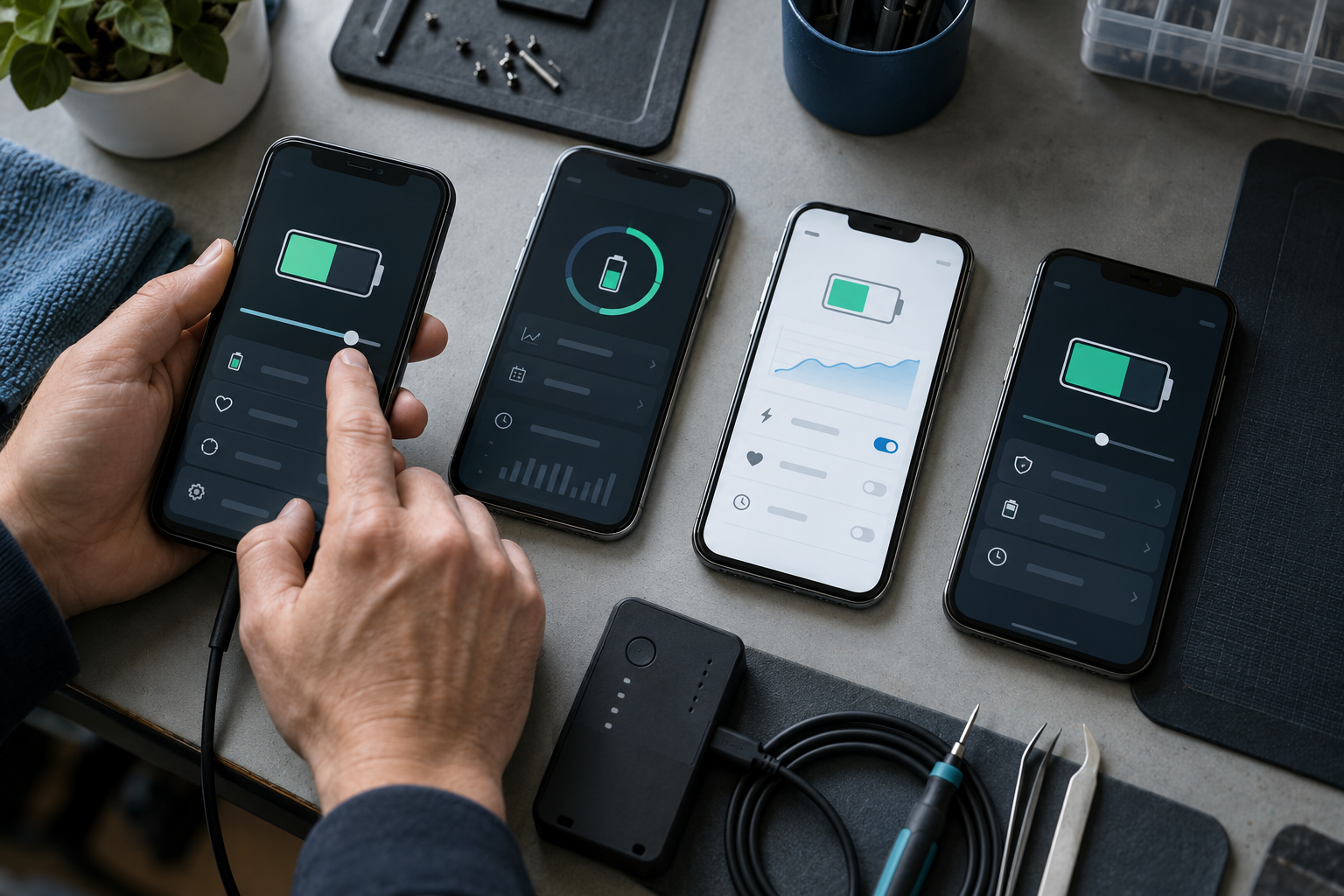
”Battery health” generally refers to a system or diagnostic method’s estimate of the battery’s currently usable maximum capacity relative to a reference capacity. It’s good for helping procurement teams set thresholds, but it’s not a complete diagnosis, nor is it a countdown of remaining useful life.
| Terminology | meaning | Can’t explain |
|---|---|---|
| Current battery level | How much is the phone charged at the moment? | How much capacity does the battery have left compared to a new phone? |
| Maximum capacity estimate | Estimated results relative to reference capacity | Can be used for months or years in the future |
| Number of cycles | The cumulative number of times consumed reaches a full capacity | It does not increase every time it is plugged in. |
| Peak performance capabilities | The state of the battery to support the device’s instantaneous power requirements | Not a substitute for capacity or endurance testing |
| Actual battery life | Continuous working time under specific usage conditions | It can’t be decided by just a percentage |
| Charging limit | Limit the charging ratio to protect lifespan | 80% charge cap does not equal 80% health |
A phone can display ”full” while having a lower maximum capacity than new phones. One cycle is a cumulative use of electricity equivalent to the full capacity of the battery, not a brief plug-in each time. The range of information provided varies by brand, model, and software; not all Android phones display directly comparable health percentages.
Apple: iPhone battery and performance · Google Pixel: Charging Optimization and 80% Cap
02 · Business costs
How does battery condition affect wholesale and resale prices?

| factors | possible business impact | Compare key points |
|---|---|---|
| Higher minimum threshold | Narrow down eligible inventory | Qualified quantity, delivery date, unit price |
| Sorting and testing | Add device-level operations and logging | Coverage, methods, evidence |
| battery replacement | Add parts, labor and retesting | Component Sources, Workmanship and Disclosure |
| After-sales responsibility | Influence supplier reservation and quotation | Time limit, scope, processing method |
| resale positioning | Determine the cost structure acceptable to the buyer | Target customers, statements and gross profit margins |
The more stringent the requirements, the less qualified inventory will typically be and may require more sorting or approved replacement work, but the final price difference must be based on the actual quote. There is no reliable formula for ”a fixed markup for every percentage point increase.”
Lower priced batches are not necessarily bad. If the battery condition is clearly disclosed, functions as required, and matches the buyer’s resale channel, it may still be a reasonable option. The key is to compare on the same terms, rather than just looking at the price of the equipment.
03 · Minimum threshold
What do you understand by 80%, 85% and higher requirements?
| request | What is stipulated? | still independent | buyer decision |
|---|---|---|---|
| At least 80% | Each qualifying device reaches 80% or above | Source, function, appearance | Does it match the target market? |
| At least 85% | Each qualifying device reaches 85% or above | Source, function, appearance | Are the quantities and costs acceptable? |
| At least 90% | Narrower capacity filtering | Source, function, appearance | Is it worth a smaller supply range? |
| Other higher thresholds | Filter by written value | Measurement error and retest process | Can the supplier deliver stably? |
| Brand new battery | Parts and Service Specifications | Health Readings and Functional Acceptance | Permissible parts and evidence of repairs |
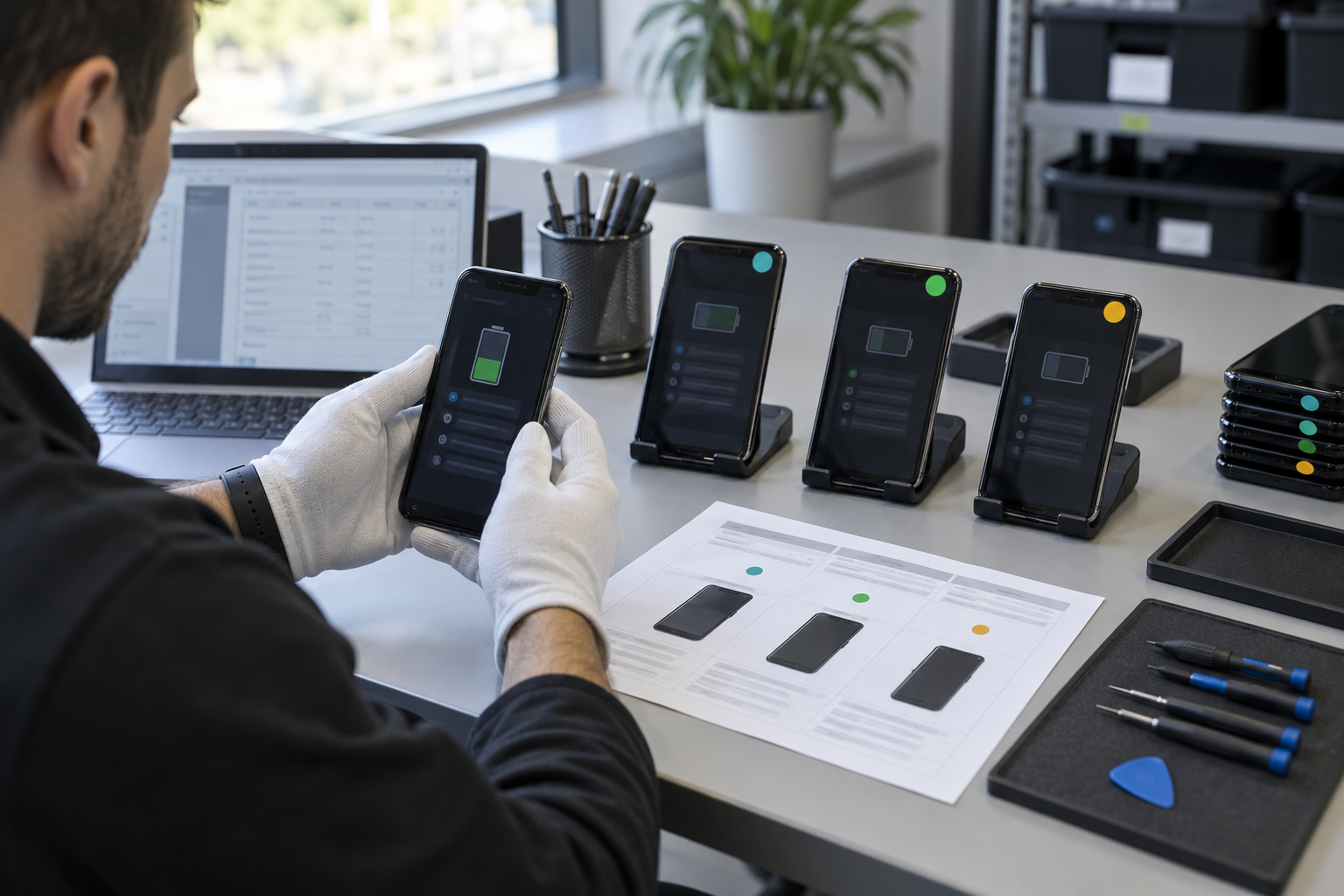
These values are procurement specifications agreed upon by both parties and are not industry-wide standards. If the requirement is written as ”at least 85% for each unit”, the average of 85% for the entire batch cannot replace meeting the standard one by one; ”more than 85%” does not include exactly 85%, and the wording must be precise.
Boundary readings must be pre-agreed on the main measurement method, re-measurement conditions and upgrade processing. Any tolerances should be written into the order and cannot be temporarily acquiesced at the time of acceptance. The manufacturer’s instructions on cycle life or maintenance under ideal conditions are used to explain product characteristics and do not automatically become the second-hand wholesale acceptance line; similarly, 85% does not guarantee 85% of the battery life of a new machine, let alone predict the remaining years.
Apple states that maximum capacity is an estimate of a relatively new battery and lists design goals for different generations under ideal conditions; this information can help understand aging but does not replace order criteria for buyers and sellers.View official description
04 · Actual performance
Why don’t health percentages describe full performance?
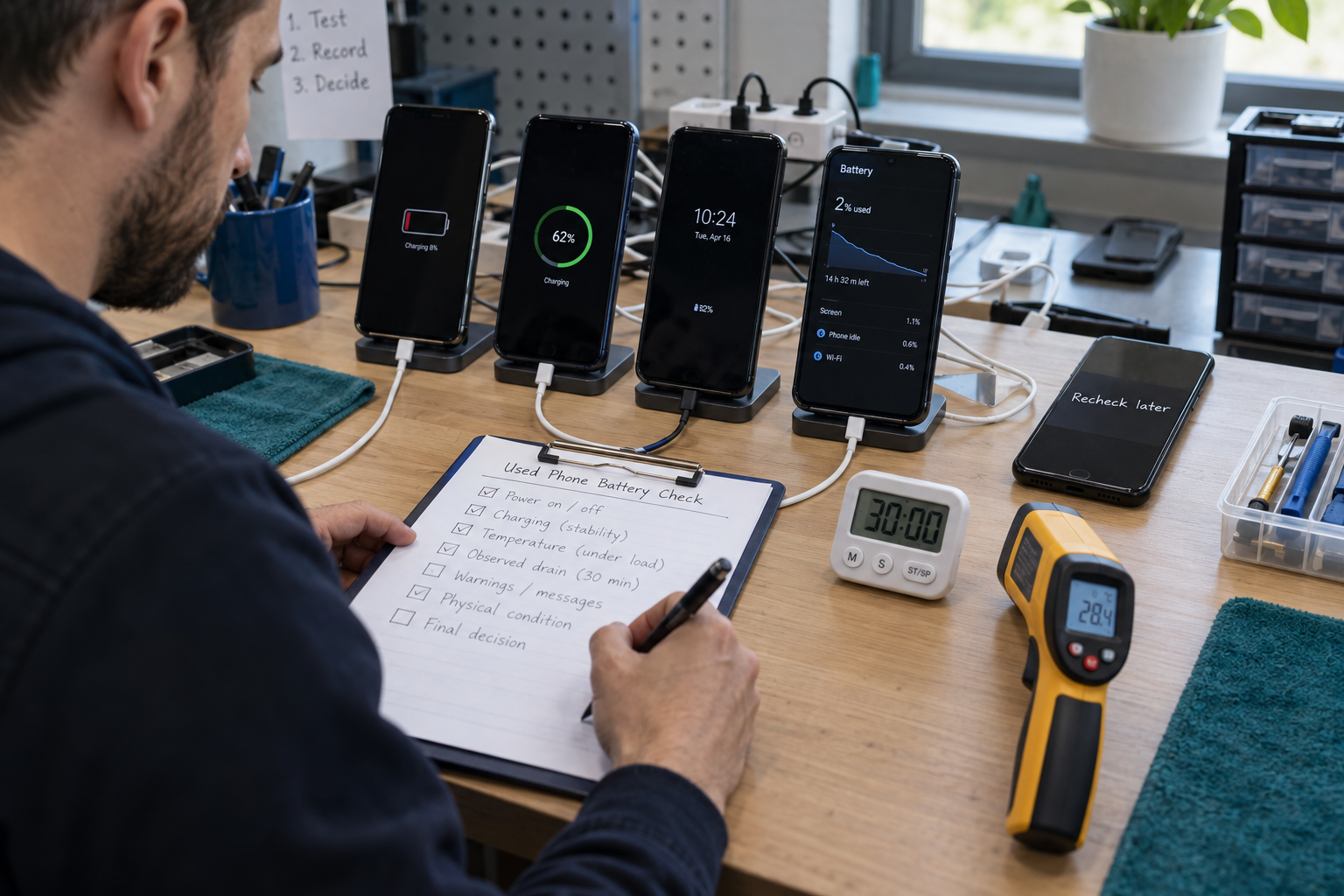
Run and charge
- Whether it shuts down unexpectedly;
- Whether the power reading jumps abnormally;
- Check whether there is abnormal power consumption under the agreed load;
- Whether charging is interrupted or repeatedly connected;
- Whether relevant service prompts appear;
- Can it support normal equipment load.
Safety and appearance
- Whether the fuselage is tilted or deformed;
- Is there any suspected signs of expansion or leakage;
- Whether there is abnormal fever;
- Whether the charging port and cable are normal;
- Whether routine testing needs to be stopped;
- Whether to refer to a qualified person for evaluation.
Battery life is affected by screen brightness, application, signal, temperature, model and test load, so health readings cannot promise a fixed number of hours. Short controlled tests provide limited evidence and cannot predict full future performance.
Natural capacity decline does not equal a safety failure. On the contrary, suspected bulges, leaks, physical damage, or continued abnormal heating are another type of risk, and routine charging should be stopped and evaluated by qualified personnel; do not open, squeeze, or confirm with intense pressure testing.
05 · Battery Source
How to distinguish between original factory batteries and replacement batteries?
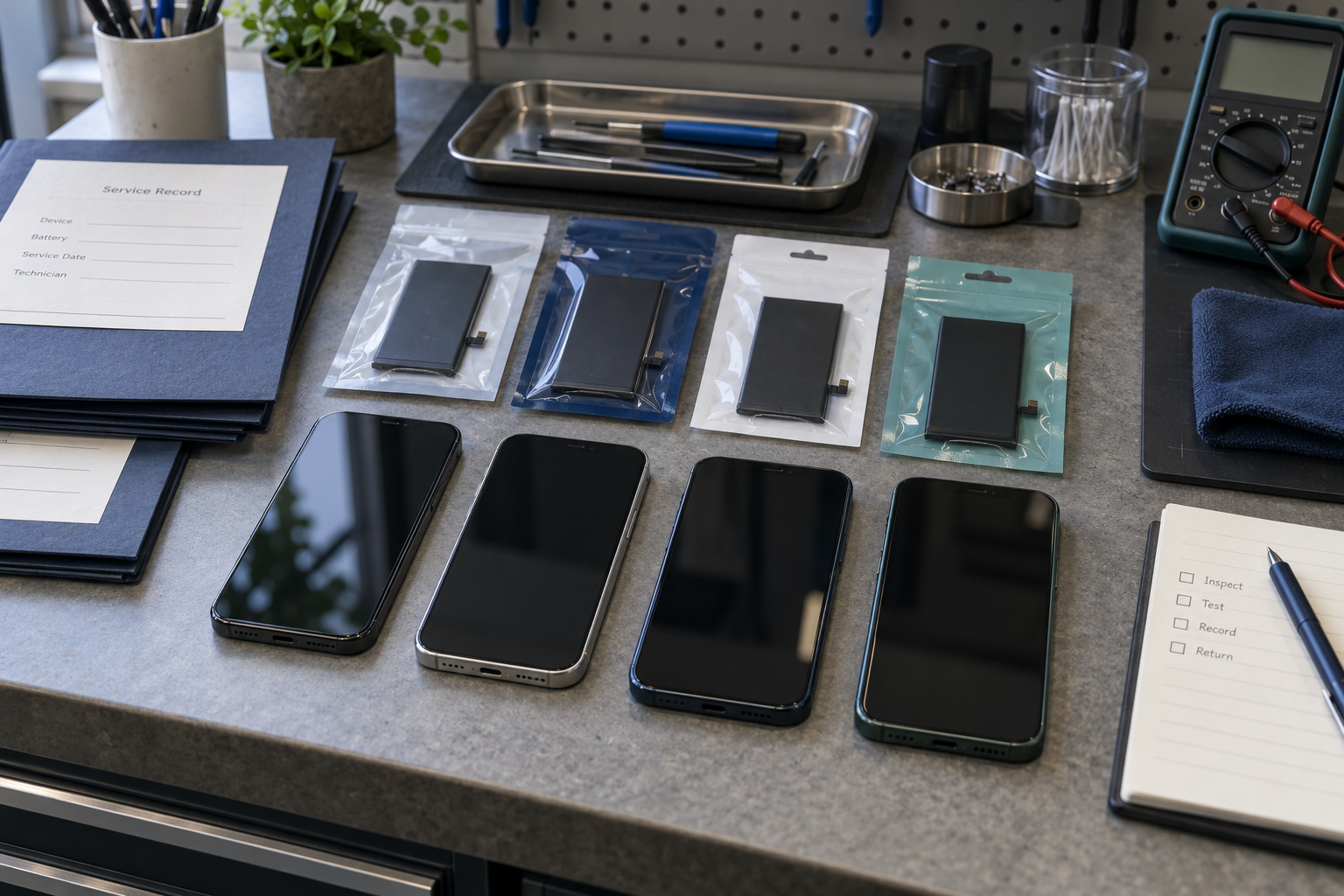
| Category | Description | Evidence should be requested | cannot be assumed |
|---|---|---|---|
| Factory original battery | Still the battery that was installed on the device when it left the factory | Available system information and vendor disclosures | It does not mean that the capacity must be high |
| Brand new original factory replacement | Repair completed with new genuine manufacturer’s goods | Repair date, records and calibration status | It does not mean that the complete device is new. |
| Second-hand original factory replacement | Genuine parts from other devices | Source Disclosure and Current Test Results | Quality is not equal to brand new genuine products |
| third party replacement | Non-original manufacturer parts | Compatibility, installation, testing and after-sales | Can’t be judged as good or bad |
| History cannot be confirmed | Lack of reliable source records | Clearly mark unknowns and add checks | No record does not prove that it has never been replaced |
”Original battery” is prone to ambiguity. Procurement documentation should require: replacement disclosure, available parts sources, repair dates or records, system repair history, relevant warnings, agreed warranty and functional results after repair.
Apple’s Parts & Repair History may show Genuine, Used, or Unknown on supported models and systems, but coverage depends on the device and software; there is no record or proof that the battery was never replaced. Showing 100% is a measurement only and not a certificate of authenticity.Apple: iPhone parts and repair history
06 · Testing records
How can I consistently measure and record battery condition?

- Identify specific equipment and associate records with internal reference numbers.
- Document the exact model and software version.
- Use a mutually agreed upon manufacturer interface or diagnostic method.
- Record the results as is and do not convert them yourself.
- Save available warnings, service information, and replacement disclosures.
- Complete agreed charging and functional observations.
- Record date, evidence and final disposition.
- List results that cannot be read or whose conclusions are unclear.
Device-level reporting fields
- Device reference number, model, testing date and software version;
- Method or tool, reported health percentage or status;
- Number of available cycles, warnings and repair history;
- Replacement disclosure, functional observation and passing/retesting/elimination disposition.
Different tools may use different data sources, reference values and algorithms. When the results conflict, the highest value should not be automatically selected, but should be reviewed according to the pre-specified master method and upgrade process. The full IMEI and serial number are kept in controlled procurement records; public examples only use masked reference numbers.
07 · Batch classification
How to divide the entire batch of equipment into clear health intervals?
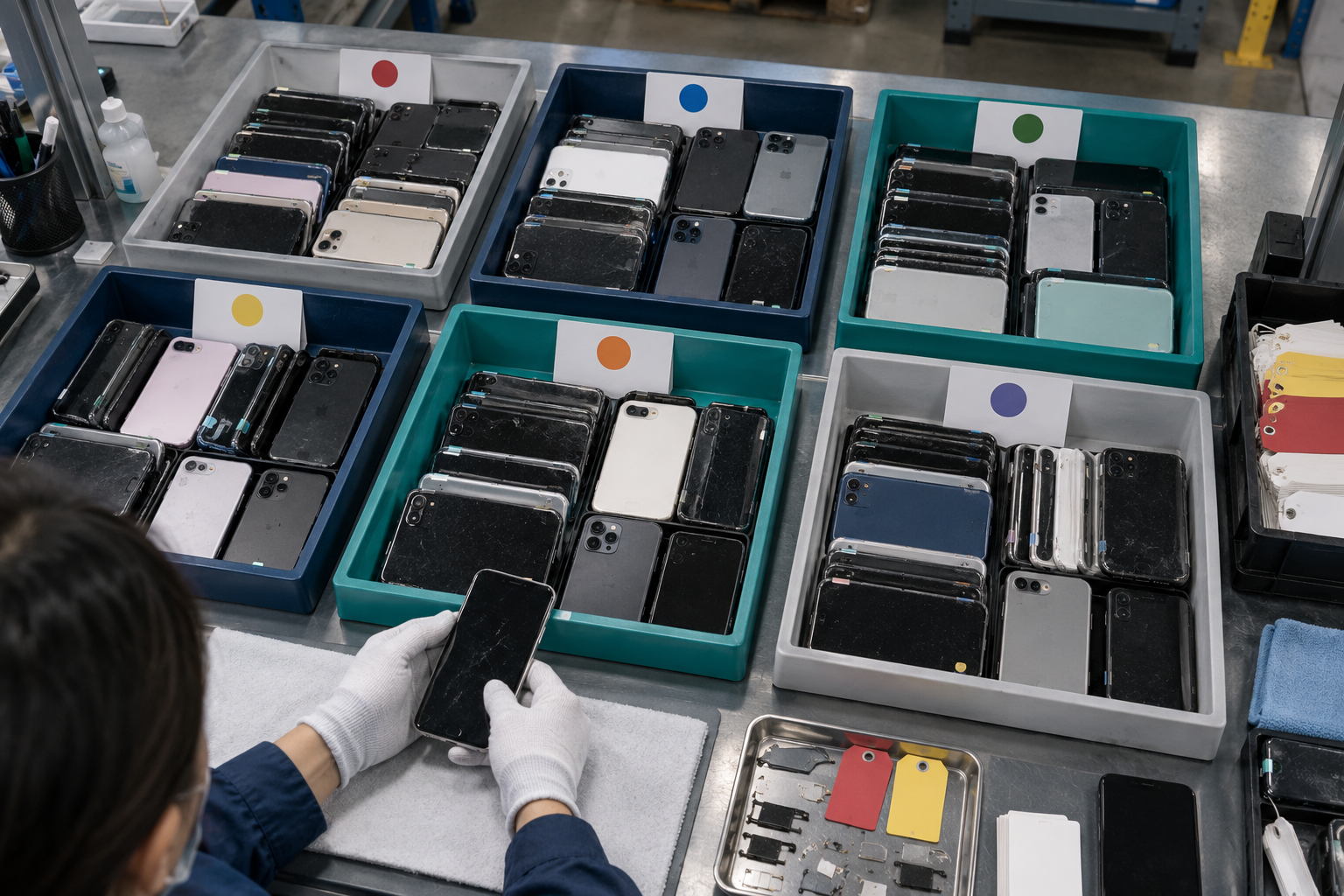
An average will mask devices below the threshold. A more practical approach would be to create non-overlapping intervals only for comparable readings, and label substitutions, battery sources, and exceptions separately.
| interval | Number of examples | Preliminary status for at least 85% of orders |
|---|---|---|
| Less than 80% | 10 | Not meeting the percentage threshold |
| At least 80%, less than 85% | 20 | Not meeting the percentage threshold |
| At least 85%, less than 90% | 35 | Enter other acceptance checks |
| At least 90%, less than 95% | 25 | Enter other acceptance checks |
| At least 95% to report 100% | 10 | Enter other acceptance checks |
| Unable to read/not verified | List separately | Processed according to order rules |
Of this hypothetical 100-unit example, 70 units meet the ”at least 85%” numerical condition, but they also pass checks such as charging, shutdown, warning, source, and physical status. This distribution is for illustrative calculations only and does not represent market inventory.
Replacement battery, unknown source, service warning, functional failure, and physical risk should be marked as independent flags and not mixed into a percentage bin. Mixed model orders must also be counted separately by model and detection method, because the same percentage does not mean the same battery life.
08 · inquiry specifications
Why should you write down your battery requirements before requesting a quote?

Products and Thresholds
- Model, capacity, version and quantity;
- appearance standards;
- Minimum battery threshold for each unit;
- accepted measurement methods;
- Unable to read result processing.
Replacement and Acceptance
- Whether battery replacement is allowed;
- Allowed substitution types;
- Information that must be disclosed;
- Test time and device-level reporting;
- Remedies for nonconforming equipment.
Rewriteable inquiry example
”Please quote by specified model. Battery health for each accepted device is at least 85% and verified using a mutually agreed upon method. Please disclose all known battery replacement and service reminders; quote eligible existing battery devices separately from approved replacement battery options. Please provide device association results and confirm how non-compliant devices will be handled.”
This is an example that can be adjusted on a project-by-project basis and is not a general specification. Changing the threshold after quoting may change the price, available quantity, rework scope and lead time, so the same version of the requirements must appear in the quote and purchase order.
09 · Delivery Verification
How to keep shipment inspection consistent with arrival acceptance?

| stage | Check | Keep records |
|---|---|---|
| Before shipment | Confirm thresholds and functions one by one according to the agreed method | Equipment reference number, time, results and evidence |
| After approval of the replacement | Recheck health, charging and warnings | Parts Disclosure, Repair and Retest Results |
| upon arrival | Match packing list and review as agreed | Receipt time, status and evidence of discrepancies |
| Discrepancy review | Retest using the main method and investigate the cause | Parties’ results, conditions and final disposition |
The current charge after shipping may be low, but that is not the same thing as the maximum capacity. Software updates, recalibration, and subsequent use may also change estimated readings, so orders should indicate how boundary changes are reviewed rather than assuming that readings will never change.
If each device must meet a threshold, sampling alone cannot prove compliance on a device-by-device basis. Equipment reference numbers should be included throughout testing, packaging and receipt; all repaired equipment should be retested and the results saved.
10 · Quotation comparison
Compare supply options by qualified quantity and total cost

| Compare fields | Need to be consistent |
|---|---|
| Products | Same model, configuration, regional version and appearance conditions |
| Battery | Minimum thresholds, methods, sources and allowed substitutions |
| Quantity | The expected qualified quantity, not the total number to be inspected |
| work | Inspection, repair, retesting and packaging included |
| evidence | Device-level logging, warnings and disclosures |
| After-sales | Notices, Terms, Remedies and Shipping Liability |
This is just a planning calculation, not a profit promise. If the two quotations use different battery assumptions, the unit price cannot be directly compared; the cheapest quotation does not necessarily bring the lowest qualified equipment cost. Battery and repair disclosures at resale should continue to be consistent with purchase records.