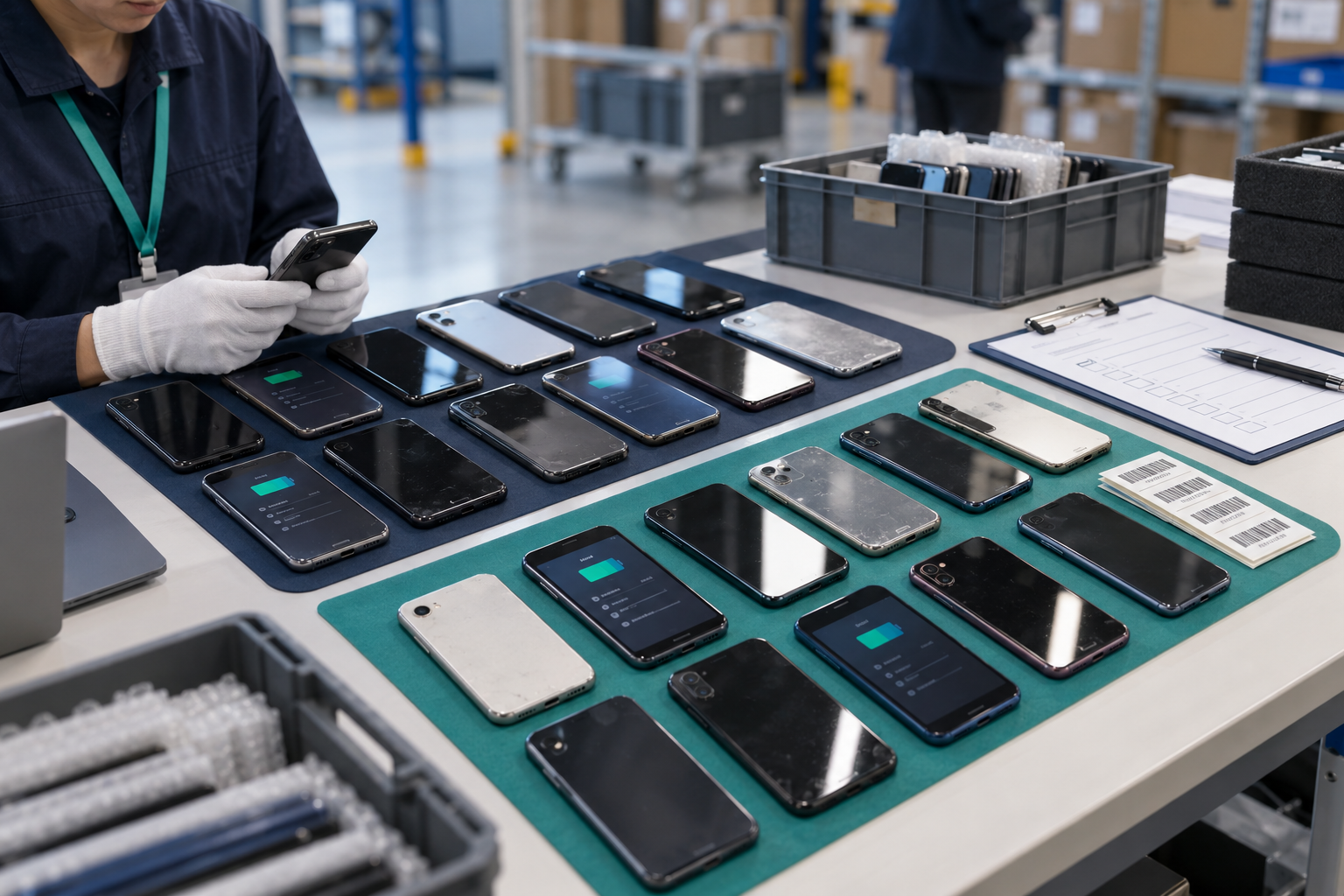


01 · Inventory location
Availability of inventory for the exact SKU changes the price basis

Inventory should be judged at the variant level, not just by the product family name. Color, capacity, RAM, regional versions and statuses in the same series occupy separate inventories respectively; if a certain variant is sufficient, it does not mean that the variant requested by the buyer is also sufficient.
| Stock status | possible price impact | buyer issues |
|---|---|---|
| Sufficient stock | May support current quotation and faster stocking | Are these quantities confirmed for sale? |
| Limited number of specified variants | Quotes may only apply to remaining quantities | Do I need to change batches when I reach the target quantity? |
| New replenishment costs vary | Old inventory and replenishment may be quoted separately | Which batch of inventory is the quote based on? |
| Old inventory cleanup | Conditional promotions may occur | Are the specs, warranty and condition the same? |
Suppliers may also have equipment that has been allocated to other buyers, incoming goods that have not been accepted, or inventory that exists on the books but has not been confirmed to be qualified. Therefore it is necessary to distinguishList display、Confirmed for saleandReserved for order。
The low price for ten units remaining stock may not necessarily apply to an order of one hundred units, as the remaining ninety units may come from restocking at different costs. Low inventory does not necessarily mean strong demand or a certain price increase; inventory structure, clearance goals and the supplier’s own costs will all affect the final decision.
02 · Product configuration
Color, RAM and storage capacity are different price points

| request | Reasons why quotes may differ |
|---|---|
| fixed color | Specified colors are available in stock and on demand. |
| Mixed colors at the same price | Suppliers can utilize multiple color stocks, but proportions need to be confirmed |
| Higher storage | It is a stand-alone SKU with different purchase costs and second-hand supply |
| Specific RAM | Only available on models that do have multiple physical RAM versions |
| hybrid configuration | Quantity should be split by variant, not replaced by an average price |
The color premium may come from available quantities or market demand at the time, rather than color material costs. There is also no fixed percentage premium for higher storage, especially in used inventory, where capacity, condition, battery, and region all combine to affect qualifying quantities.
Not all brands allow buyers to independently select RAM; nor does software ”expanded memory” equal physical DRAM. The full model code should be used when comparing quotes and have the supplier return the actual configuration item by item.
03 · Product cycle
New product launches reallocate demand and inventory, but there is no fixed timetable

| stage | Likely market reaction | Why the results are different |
|---|---|---|
| Before publishing | Some buyers wait and see, channels adjust inventory | News credibility and regional rhythms vary |
| after release | Attention turns to new models, old models may be on sale | There may still be stable demand for older models |
| first batch supply | The supply of new models is uneven across regions, and old models bear replacement demand. | Listed in different countries and carriers |
| Subsequent replenishment | The supply structure gradually changes, and trading in old ones for new ones increases second-hand inflows | Capacity, color and status distribution are different |
After new products appear, retailers or distributors may clear out old inventory, and trade-in may also increase the source of second-hand equipment. However, if there is still project demand for the discontinued configuration, it may remain stable, or even become more difficult to procure due to reduced availability.
SellCell’s data is based on the comparison of the highest consumer resale price of multiple recycling buyers in the United States with the first MSRP. It is suitable for observing the recycling value of the consumer side. It is not a wholesale transaction price index, and its depreciation percentage cannot be directly applied to B2B orders.View its data method
04 · Cross-border exchange rates
Purchase currency, quote currency and buyer’s local currency may be different

The above exchange rates are for explaining mathematical relationships only and are not current exchange rates and do not include bank fees, profits, shipping and other costs. Under these assumptions, a weakening of the RMB against the U.S. dollar will reduce the cost of converting to U.S. dollars; the opposite direction will increase the converted value.
Actual quotes do not necessarily transmit exchange rate changes immediately or completely. Suppliers may use previously purchased inventory, internal pricing bands, negotiated contracts, or hedging arrangements. The U.S. International Trade Administration pointed out that cross-border buyers and sellers need to agree on the transaction currency, and changes in exchange rates between transaction and payment will cause risks; the focus is on risk management, not speculation.View official description
05 · Second-hand equipment
Status and battery requirements change qualifying inventory and readiness

| status factor | Must be written clearly |
|---|---|
| Appearance and screen | Scratches, Dents, Cracks, Screen Burn and Acceptable Ranges |
| Battery | Unit-by-unit minimum values, methods, replacement states, and exception handling |
| Repairs and parts | Repair history, parts sources and disclosure standards |
| Functional testing | Camera, network, audio, charging and sensor coverage |
| restricted status | Account lock, carrier lock, blacklist and financing status |
| Packaging and after-sales | Shipment Contents, Warranty, Return Window and Responsibilities |
A+, A and B are not universal grades. Suppliers can use different appearance thresholds, while battery, repair and functionality are often independent criteria. Therefore, a low unit price may correspond to a lower acceptance standard and is not a discount for equivalent products.
Each unit is required to have at least 85% battery health, and at least 80% may result in different qualified inventories or preparations, but fixed price differences cannot be extrapolated out of thin air. A battery that is original but has aged is also different from a replacement battery that has been recorded and retested. Apple defines maximum capacity as a measurement relative to new battery capacity and explains that chemical aging reduces capacity and peak performance.Check out Apple’s official instructions
06 · Regional SKU
Global version and Mainland China version should be considered different SKUs

| Version details | Why it matters when comparing prices |
|---|---|
| Hardware model | Determine the true version identity of the device |
| Frequency bands and operators | Affects destination network availability and acceptance policies |
| SIM/eSIM | Different markets may use different combinations |
| Firmware and Services | Languages, pre-installed services, and Google services may vary |
| Packaging and accessories | Plugs, chargers and materials may vary |
| Warranty area | After-sales qualifications may be restricted by sales region |
You cannot make a general claim that the global version is always more expensive, or that the Chinese version is always cheaper. Availability locations, regional promotions, distribution arrangements, local demand and destination can all change the price quoted for a specific version.
The ”global ROM” installed by the seller does not prove that the device belongs to the official global hardware version. Buyers should check the exact model code, destination country, target operator, frequency band, SIM structure, software and after-sales before accepting a low-priced regional version.
07 · Parts cost
Memory and other components affect the complete device price through different paths

| cost changes | main conduction path | Important limitations |
|---|---|---|
| DRAM/NAND | New machine production and subsequent replenishment | It’s not a complete device. The price changes instantly on a one-to-one basis. |
| Display | Production, repair and refurbishment | Depends on the actual equipment that needs to be replaced |
| Battery | Replacement parts, labor and retesting | Not every batch of equipment needs to be replaced |
| Cameras and other components | Make or model specific repairs | Impact depends on specific model and failure rate |
RAM usually uses DRAM, and internal storage usually uses NAND Flash. The two cannot be mixed into the same component. Purchased inventory, long-term supply contracts, promotions, margin arrangements and end demand may all delay or offset component cost changes.
TrendForce released in February 2026 DRAM and NAND contract prices for the first quarter of 2026Forecast, not the actual measured increase in transaction prices of all mobile phones. It can explain the storage supply environment, but it cannot directly multiply the chip percentage by the complete device price.View original forecasts and dates
For used devices, higher chip prices don’t mean suppliers buy new memory for every old phone. The impact is more likely to occur indirectly through new replacement machine costs, repair parts, channel demand or replenishment opportunities.
08 · Complete trading scope
Quantity, packaging and delivery terms can create ”superficial price increases”

Products and preparation
- Quantity per SKU;
- Mixed model processing;
- Chargers and cables;
- Original box or replacement packaging;
- Check range and battery replacement.
Delivery and Responsibility
- Shipping costs and insurance;
- duties and taxes;
- payment-related costs;
- Destination charges;
- Warranty and Return Terms.
The unit price of goods and the total cost of delivery are not the same concepts. The updated quote may add inspection, accessories, packaging, shipping or after-sales services that were previously omitted, or it may simply list costs that were originally unresolved.
Suppliers should be required to mark each cost as ”included,” ”not included,” or ”to be confirmed,” rather than directly judging the phone itself to be more expensive. Larger orders do not guarantee lower unit prices; if the exact SKU becomes scarce, filling larger quantities may require the use of replenishment at a different cost.
The U.S. International Trade Agency recommends that international quotes describe the product, unit price, total price, Incoterms, payment, estimated shipment and expiration date; this information helps to provide a unified basis for comparison.View the Proforma Invoice Guide
09 · Time Boundary
Why do wholesale quotes need an expiration date?

| Terms | What should be explained |
|---|---|
| Issuance and expiration | Date, time and time zone |
| Product range | Accurate SKU, status and quantity |
| Currency | Quotation and payment currency |
| Inventory reservation | Whether to reserve, reservation quantity and trigger conditions |
| Order confirmation | Accept a quote, contract, payment or other step |
| delivery assumptions | Packaging, Route, Incoterms and Estimated Time |
| after expiration | Price and inventory re-confirmation process |
Validity periods let buyers and sellers know the time boundaries of an offer, but should not enforce a uniform 24 hours, 48 hours, or seven days. Reasonable periods depend on inventory, transaction complexity and mutual agreement.
The price is still within the validity period and does not mean that the inventory is automatically reserved. After expiration, the price may rise, fall, or remain unchanged, and the buyer should reconfirm. Market changes do not automatically allow suppliers to unilaterally modify agreed orders; whether adjustments can be made depends on the terms of the contract and order.
10 · Buyer Actions
When facing a change in quotation, which variable should be determined first?

- Keep RFQ product specifications consistent.
- Record the date and revision of each quote.
- Compare identical SKUs to acceptance criteria.
- Ask which costs or terms have changed.
- Separate price adjustments from inventory replacements.
- Confirm current actual available quantities.
- Verify full purchase and delivery costs.
- Obtain written confirmation before placing an order.
Ask the supplier
- Has the exact model number not changed?
- Have status and battery requirements remained unchanged?
- Has the currency or delivery basis changed?
- Has it been replaced with new replenishment?
- Has the actual quantity available changed?
- What is the new validity period?
Three purely hypothetical examples
- The supplier’s currency price remains unchanged, but the buyer’s local currency cost is higher;
- The unit price is lower, but the battery threshold is changed from 85% to 80%;
- Original inventory is sold out and new restocking costs vary.
These examples only explain possible mechanisms and cannot prove the reasons why a certain supplier actually adjusts prices. The most reliable course of action is to ask the supplier to go line-by-line and provide an updated written quotation that includes the new specifications, quantities, currencies, delivery bases and validity periods.